
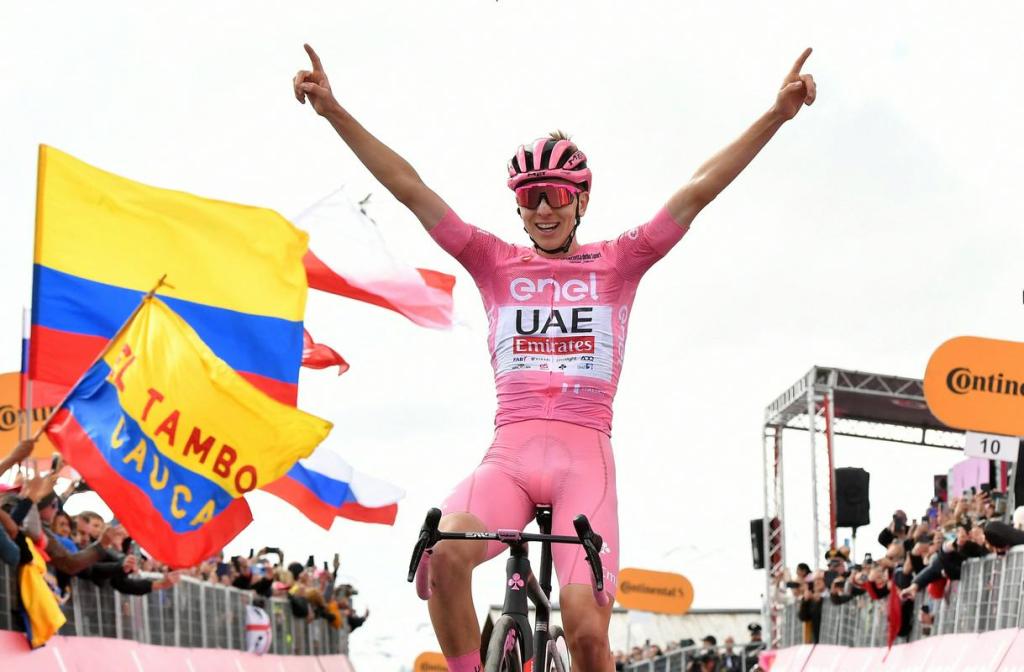
On a day that will be remembered in the annals of cycling, Tadej Pogačar demonstrated his exceptional talent and relentless spirit by claiming victory on Stage 15 of the Giro d’Italia. The young Slovenian rider, who has already made a name for himself with stunning performances in other grand tours, delivered an impressive ride that left fans and competitors alike in awe.
The Stage: A Grueling Challenge
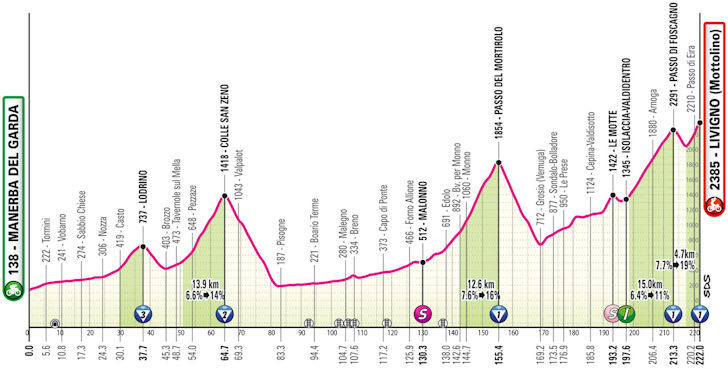
Stage 15 of this year’s Giro was a test of endurance and skill, stretching well over 200 kilometers with several daunting climbs. The route, which started in Manerba del Garda and ended at the summit of Mottolino (Livigno), was designed to challenge even the most seasoned riders. With over 5400 meters of elevation gain, it featured the kind of demanding terrain where champions are made and broken.
The key sections included the grueling ascent of the mythical Passo del Mortirolo and the final, punishing climb to Livigno, which is divided into two climbs, Passo di Foscagno and Mottolino. These segments were anticipated to be the decisive moments of the stage, offering a perfect battleground for climbers to make their mark.
The Breakaway
The first breakaway of the day formed immediately after the start, with a group of 12 riders making the initial move. On the first climb to Lodrino (Category 3), the peloton began to split, and a large group of more than 40 riders broke away. Within this group, only Michael Storer (Tudor) was less than 10 minutes behind the leader.
Just before the summit of the San Zeno Pass (Category 2; 13.9 km at 6.6%), the two breakaway groups merged into one large group, which at one point included 58 riders. From this large group, six riders managed to break away.
After a 60-kilometer stretch in the valley, the riders faced the infamous Mortirolo Pass, albeit from the “easier” Edolo side (12.6 km at 7.6%). The initial breakaway attempt from this group was unsuccessful, and Christian Scaroni (Astana) was the first to crest the Mortirolo. Domen Novak and Vegard Stake Laengen of UAE Team Emirates took charge of pacing the peloton, reducing the gap to the pink jersey group to under five minutes.
With 40 kilometers remaining, a group of 18 riders, none of whom were general classification threats, led the race, while the peloton trailed by just under four minutes.
Pogačar’s Spectacular Attack
After Valtellina, the riders tackled a short climb to Le Motte, which fragmented the leading group into several smaller groups. The peloton was trailing by a little over three minutes.
The longest climb of the day, the Passo di Foscagno (15 km at 6.4%), loomed ahead at 2291 meters above sea level. German rider Georg Steinhauser attacked here and, with 15 kilometers to go, had a one-minute lead over his chasers, with 2014 Giro winner Nairo Quintana (Movistar) closest behind.
Around 15 kilometers from the finish, Tadej Pogačar launched a powerful attack from the peloton, quickly creating a gap. Ten kilometers from the finish, Quintana caught Steinhauser and pressed on alone. Nine kilometers from the finish, Pogačar overtook Steinhauser, leaving only Quintana ahead, with a gap of 40 seconds.
Following a brief descent, the final climb to the finish in Livigno on Mottolino awaited: 4.7 km at 7.7%, with gradients peaking at 19%. Pogačar continued his relentless pace on this climb, overtaking Quintana with two kilometers remaining. At this point, it was clear that victory was his, but we must mention an incredible ride from the Colombian who looked really impressive in the high mountains.
Aftermath and Reactions
The cycling world reacted with widespread admiration for Pogačar’s ride. Teammates and competitors alike praised his strength and also strategy. Social media buzzed with excitement, and analysts began to ponder the implications for the remaining stages of the Giro.
For Pogačar, this stage win was more than just another victory; it was a statement. It underscored his ambition and capability to not only compete but dominate in one of cycling’s most prestigious events.
 La fuga de la fuga
Komentiraj